Sunday, October 27, 2013

TOW #7 - The Republic of Pirates: Being the True and Surprising Story of the Caribbean Pirates and the Man Who Brought Them Down by Colin Woodard


Many of the famous pirates people know today such as Samuel "Black Sam" Bellamy and Edward "Blackbeard" Thatch came from the Golden Age of Piracy. Source: www.crwflags.com


                In a chapter in his book The Republic of Pirates, Colin Woodard explains to his adventure loving audience about the people who played crucial roles during the time between June of 1716 to March of 1717 in order to set the stage up for the great event where all of these characters' lives would be intertwined. Samuel Bellamy was a penniless sailor who became a commodore of a gang of pirates within a year. In search of recruitments after a failed attempt to capture a French ship, Bellamy went to a harbor named ST. Croix to avoid a gale where he accidentally found a band of lost and hungry pirates. Eventually, they captured a great battle ship called Whydah by using the essence of fear as a weapon. At a young age of twenty-seven, Bellamy officially became a pirate king. Meanwhile, Captain Benjamin Hornigold, a pirate who still considered himself as a servant of his county England, decided to give a captured sloop that would be an excellent pirate vessel to his protégé, Edward Thatch. Thatch, better known as Blackbeard who would one day be the most powerful pirate in the Atlantic, finally had a ship that he could control for pirating purposes. During all these commotions at the sea, a former privateer Woodes Rogers was planning to end piracy once and for all by forming a corporation named The Copartners for Carrying on a Trade & Settling the Bahama Islands. His wish of being a governor and garrison commander of the Bahamas was granted, a wish that he would soon regret. Throughout the chapter, the author uses metaphors and personification in order to help the audience to imagine each event with clear details. When describing the harbor of St. Croix, Woodard says, "On the reef guarding the harbor entrance, the surf battered at the charred remains of a vessel" and the rhetorical devices used here strengthens the descriptions. I believe that the author did a great job explaining all the necessary information in order to show how one man ultimately ended the Golden Age of Piracy.

Sunday, October 20, 2013

TOW #6 - Bikinis versus Burka by Malcolm Evans


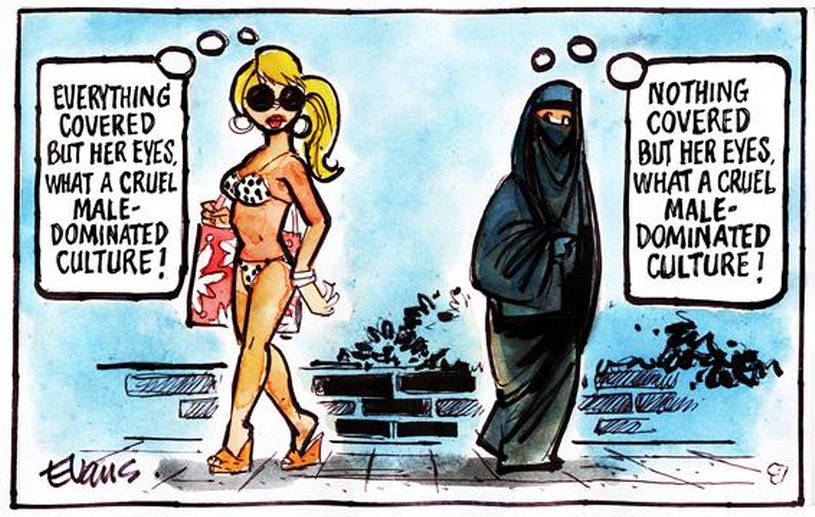
But who is really being dominated here? Source: http://thesocietypages.org


            In Malcolm Evans's cartoon, Two women can be seen with very different attires, one in bikinis, and the other in a burka, a full body cloak worn by some Muslim women. The two are looking at and pitying each other as they are passing by, thinking that the other woman is living in a "cruel male-dominated culture". Obviously, the woman on the left with the bikinis represents a stereotypical U.S. woman who is not used to the idea of being "forced" to wear a piece of clothing that covers everything except for the eyes, and she believes that women in the U.S. are the most liberated . The woman on the right, on the other hand, represents a stereotypical Muslim woman who believes that wearing bikinis or any other forms of clothing that reveals too much skin oppresses  women because of too many evaluative eyes and possible negative appraisals, and she believes that Muslim women are more liberated than U.S. women. This cartoon is for everyone, but it is specifically aimed at two different groups of people - Americans and Muslims - to show that their ideas of women's oppressions might be different from others'. Evans, a very experienced cartoonist, probably wants both groups to stop feeling sorry and to respect each others' views on personal freedom, because wearing bikinis or burkas might be out of their own choice. The author wants everyone to know that both cultures have their benefits and drawbacks. It is true how in some countries, women are forced to wear certain attires, but  wearing burkas might allow women to care less about their physical looks, unlike many women around the world looking for plastic surgeries. Evan's successful use of juxtaposition shows deep comparisons and contrasts between the clashing cultures. The juxtaposition also creates a sense of humor (despite the seriousness of the topic) because the two women with vastly different cultural background think the same about the women's oppression. I believe that the cartoonist was successful in getting his ideas across his audience without being heavily biased.

Sunday, October 13, 2013

TOW #5 - Arrest in Baby Hope Case Brings Closure to Police by Coleen Long


A flyer in the neighborhood where Anjelica's naked, malnourished corpse was discovered. In it, pictures of the girl and a photograph of the cooler where her body was stored can be seen. There is a $12,000 reward for any information that could lead to an arrest of the murderer. Source: thenypost.files.wordpress.com


            After two decades, the murderer of a little girl nicknamed Baby Hope was arrested by detectives who did not give up on the case for all these years. Conrado Juarez, the cousin of the 4-year-old victim, was interrogated on Saturday, in which he admitted his sexual assault and smothering of Baby Hope in 1991. For many years, the case had been an enigma until the new DNA testing came out, revealing Baby Hope's mother and the real name of the girl: Anjelica Castillo. After these discoveries, it took little time for the detectives to find out that Juarez killed his cousin in his sister's apartment, put the body in a cooler, and then dumped the cooler in Manhattan with the help of his sister. Police commissioner Raymond Kelly praised Jerry Giorgio, Joseph Reznick, and other detectives who worked on the case for their efforts because "they were unrelenting". These detectives were the people who organized Anjelica's burial in 1993, in which hundreds of people came to express sympathy for the girl they never knew.  On her tomb, there are two little angels and a headstone that reads: "Because we care". The author of this news article was obviously trying to show the audience, possibly consisting of some people who knew about the case since 1991, that justice has been served, even though it took the detectives two decades to find the murderer of the four-year-old kid. The author tries to create a unified sense of sympathy toward Anjelica by mentioning her burial and her tomb stone. The fact that many people visited her grave shows that these people really did care even though they might have never met the girl before, and shows that the readers would most likely feel the same (I certainly did). While honoring the memory of Anjelica, the author also manages to establish her credibility by including exact date of each event and quotes in her writing.

Sunday, October 6, 2013

TOW #4 - Kidnapped by Terrorists: One Boy's Story of Escape by Susan Svrluga


Gerfa's and Kevin's passports. The mother and son were held as captives by a group of Filipino terrorist group called Abu Sayyaf for months. They were doomed to die unless a ransom money of $10 million has been paid. Source: www.rd.com


            Susan Svrluga's writing, "Kidnapped by Terrorists One Boy's Story of Escape" is an account of a boy escaping from his captors after five months of hostage. The story takes place in the Philippines in 2011, where 14-year-old Kevin Lunsmann and his mother Gerfa were visiting family on Tictabon Island. The two were soon kidnapped by a group of terrorists before they could go back to Lynchburg, Virginia and were taken to a forested island where they were to be killed unless Kevin's father, a maintenance man, paid the ransom of $10 million, almost an impossible task. For a long period of time, the mother and son were put into a tiny makeshift cage, treated brutally, and fed with unusual foods that made them sick. Gerfa was freed after two and a half months when a part of the ransom had been paid off, but Kevin was still in captivity. After five months being a hostage, Kevin could not take it any longer and soon escaped when the only guard in the room went upstairs for a while. Eventually, Kevin ran into a farmer who soon called the police after hearing his story. Kevin was rescued by a helicopter, and he soon returned home just in time to celebrate Christmas with his family. The casual readers of the Reader's Digest would most likely feel sympathy and relief towards the Lunsmann family, just the effect that the author of the writing would want. Svrlug,a attempts to bring out the reality of one boy's dangerous adventure  by adding vivid descriptions to the story. When she describe the time when Kevin found a pair of boots in a empty hut, she informs the readers that "[Kevin] pulled them onto his blackened, torn feet and took off again" (Svrluga). This short description shows how much the boy was suffering while running away from the terrorist, which ultimately supports the author's purpose of creating a sense of sympathy in the audience. I believe that Svrluga's fast-paced story successfully helped me to feel concerned and relived throughout the story.

Sunday, September 29, 2013

TOW #3 - The Republic of Pirates: Being the True and Surprising Story of the Caribbean Pirates and the Man Who Brought Them Down by Colin Woodard


This picture is a popular depiction of Woodes Rogers with his family.  Rogers is portrayed specifically so that his disfigurement from a musket ball wouldn't be shown. Source: wikimedia.org

            In a section of The Republic of Pirates, Colin Woodard attempts to give an account of the adventures of Woodes Rogers, a famous English privateer who legally plundered merchant vessels for his country, to the audience of adventure-lovers. Rogers's journey started with a visitor named William Dampier, a formal captain of his ship HMS Roebuck. Rogers decided to support Dampier's plan of plundering the Spanish treasure fleets that were shipping unbelievable amounts of riches from the new world to Spain. With the two ships Duke and Duchess, Rogers and his crew started to head towards the Pacific on August 1, 1708. The group faced numerous adversities such as mutinies, dangerous ocean waves, scurvies, bubonic plagues, and quarrels between officers. Along the way, the crew met and rescued Alexander Selkirk, a castaway who was once a crew member of Dampier's ship who decided to "take his chances on the island" (Woodard 76) due to Dampier's poor leadership. Selkirk would later inspire Daniel Defoe to write his famous novel, Robinson Crusoe. Much time had passed without a single treasure fleet in sight, when suddenly a galleon appeared on the horizon. The privateers managed to take over one Manila ship, but when the privateers reached their homeland, most of their plunders were seized by the East India Company's agents. Rogers received about £1,600 for his three years of service, and most of the crewmen received nothing even though the riches the privateers got were over £100,000. Rogers, however, forever became a national hero for capturing a Manila ship and circumnavigating. Throughout the story, the author uses raw diction in order for the audience to vividly imagine the adventures of Rogers. Woodard describes  the privateer by saying, "Rogers, his face mutilated, his foot mangled..." (Woodard 84), which creates a gruesome picture in people's minds. I believe that Woodard's account is accurate because he supports his claim with statistics and quotes. Woodard is also an award-winning journalist, adding on to the story's credibility. I think that he accomplished his purpose by successfully using rhetorical devices.

Sunday, September 22, 2013

TOW #2 - Fingerprint Passwords for the NSA by Tom Toles


Are people really protected by the government surveillance? Source: synd.imgsrv.uclick.com

            The cartoon shown at the top takes place in a modern U.S. society, and it shows a man who is pressing his finger against his Smartphone, and right next to him is a National Security Agency (NSA) building.  The man, obviously thinking that by scanning his finger he will be safe from government surveillance, is actually being monitored by the NSA. His plans are completely backfired because the NSA obtains his fingerprint that he scans on his phone. To make the matters worse (or funnier, whichever works), the organization uses the man's camera in the Smartphone to take some mug shots of him. NSA takes the poor guy's personal information without being suspected at all by using believable ads. Tom Toles successfully uses irony of a guy who accidentally gives out his personal information in the process of trying to get some privacy to create a sense of humor that appeals to pathos. Using this rhetorical device, the cartoonist is able to persuade the U.S. civilians that  although NSA's job is to gather secret information, it may also eavesdrop on a group of normal people like the people reading this cartoon. Toles probably wants his audience to be careful with anything that might give away any personal information because nobody knows what groups of people might get their hands on it. Although this cartoon is very humorous, there is an underlying message that is very serious. It warns that "YOU might be the next one to lose your privacy." I personally believe that Tom Toles did a great job showing his message in his cartoon strip. The way the cartoonist drew the man and the phone very simply seems to show that he is not referring to a specific person that this kind of event happens to; he shows that this can happen to everyone, so everyone must be careful. 

Sunday, September 15, 2013

Tow #1 - A Bookless Library Opens in San Antonio by Josh Sanburn


This is an inside view of the Bexar County Digital Library, the nation's first all-digital public library. Notice how there are no printed materials, but only computers and e-books. This future library is now here. Source: http://bexarbibliotech.org

            In his writing A Bookless Library Opens in San Antonio,  Josh Sanburn makes the lovers of their e-readers consider whether or not a bookless library is really a library. The author starts off his writing with the description of Bexar County Judge Nelson Wolff who opened the nation's first all-digital public library. The ironic thing is, Wolff used to detest the idea of digital reading, and he still does not own a single e-reader. According to Sanburn, the library that was built with county tax money and private donations are filled with computers, iPads and laptops, but does not have any printed material. The author soon explains that libraries are adapting to new technologies and drifting away from print to provide different programs and services. However, there are funding problems for libraries, and conflicts with publishers over e-book access that might hurt Bexar County Digital Library. Because e-books never has to be replaced and can be shared among multiple library branches, Publishers feel justified in raising the prices of the e-books or not selling them to libraries. This is a big problem for the library because people might not use the library if they cannot find the e-book they are looking for, but Wolff believes that everything will work fine if he supports the library with his annual budget. Throughout his article, Sanburn includes many statistics to back off his points, making his writing very credible. The author interacts with his readers by using the word "you" such as in the sentence, "Bexar County Judge Nelson Wolff isn’t the man you’d imagine as the visionary for the nation’s first all-digital public library" (Sanburn). He also uses the irony shown above as a hook, which allows the readers to quickly grow curious about the topic. His writing gives straight facts to allow the readers to decide whether digital libraries are a good idea, which might be the reason why Sanburn wrote the article in the first place. I believe that he achieved his purpose by remaining neutral throughout the entire writing.